

Volvo Construction Equipment at the Port of Baltimore

Updated: Feb 24
Original: Alexis Marsh
Editor: Morgan White

The Port of Baltimore isn’t just about shipping containers—it’s a hub for massive construction machines, too. Volvo Construction Equipment (VCE) moves hundreds of machines through the port each year, helping construction, mining, and demolition projects across the U.S. Without ports like Baltimore handling these heavy machines, large-scale projects would slow down, jobs could be delayed, and businesses would face higher costs.
Volvo Construction Equipment started nearly 190 years ago in Sweden and is now a global giant, employing over 15,000 people worldwide. The company manufactures machinery such as excavators, wheel loaders, haulers, compactors, pipelayers, and demolition equipment. Many machines are electric, reflecting Volvo’s focus on sustainability and innovation. Customers can even customize equipment to meet specific project needs.
With manufacturing plants in Sweden, France, Germany, Poland, the UK, the U.S., Brazil, India, China, and Korea, Volvo is truly global. Their service network supports maintenance, training, safety programs, and financing, ensuring machines stay productive wherever they are used.
In 2024, the U.S. imported 1,015 Volvo machines, and the Port of Baltimore received 452 of them—about 45% of all VCE imports. That’s 13,937 tons across 266 shipments, with an average shipment weighing roughly 53 tons. Other ports like Brunswick, Charleston, Galveston, and Tacoma received smaller volumes. Baltimore’s dominance demonstrates that the Port’s investments in developing strong roll-on/roll-off (Ro/Ro) facilities at the Dundalk Marine Terminal enable the movement of record amounts of heavy, wheeled or tracked equipment.
Of the 266 shipments to Baltimore, around 69% stayed in the U.S., while 31% were transshipped to places like New Zealand and Australia. Shipment weights ranged from as little as 2 tons to more than 441 tons, showing the wide variety of Volvo equipment sizes.
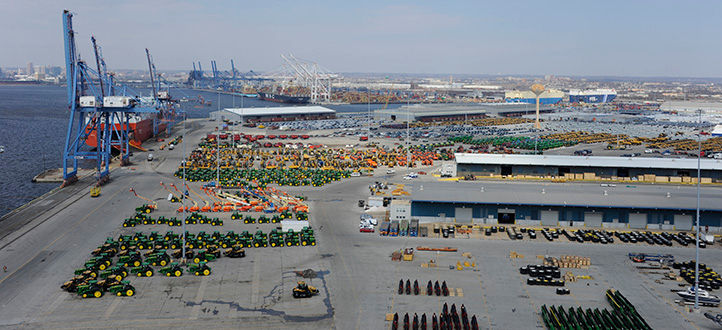
More than twenty vessels carried these shipments, including the APOLON HIGHWAY, DONINGTON, HOEGH BERLIN, POLARIS HIGHWAY, and VICTORIA HIGHWAY. Eleven consignees across the U.S. received equipment, with Volvo CENA LLC in Shippensburg, Pennsylvania, taking about two-thirds of the shipments. This Volvo distribution hub helps deliver machines to inland locations quickly and efficiently.
Volvo machines are used in a variety of industries. Cox Construction in Ontario relies on electric excavators, Robles1 in Texas uses compact electric machines for safe interior demolition, and Molly Pitcher Dairy in Shippensburg operates a Volvo L25 Electric Compact Loader for farm work. These machines make projects safer, faster, and more sustainable, showing how global shipping affects local industries.

Volvo Construction Equipment’s presence in the Port of Baltimore highlights the port’s role as a critical gateway for heavy machinery. Its Ro/Ro infrastructure, central location, and connections to inland distribution centers make Baltimore a key link in Volvo Construction Equipment's global logistics chain. Efficient port operations help keep construction projects on schedule, support jobs, and boost the economy.


